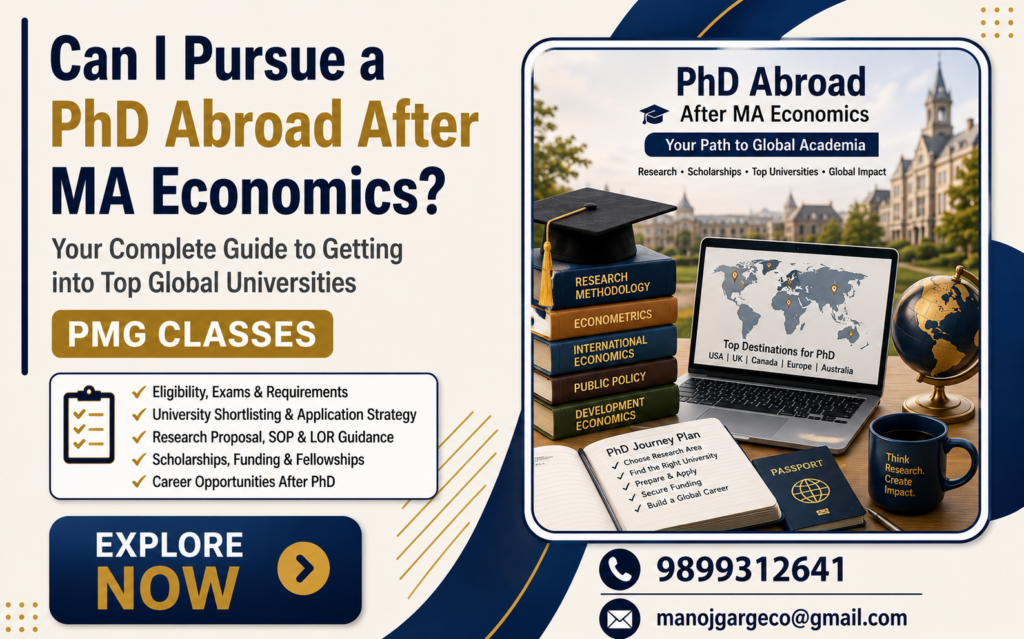
Can I pursue PHD abroad after MA Economics?
“Can I pursue a PhD abroad after MA Economics?” This is a question we hear constantly from ambitious students in our classrooms. The short and direct answer is: Yes, absolutely. In fact, an Indian Master’s degree in Economics is one of the strongest stepping stones to fully-funded doctoral programs in the US, UK, and Europe.
Every year, countless students start their journey as wide-eyed BA Economics Honours undergraduates, unsure if they should enter the corporate world or dive into academic research. We get it. The pressure to make the right choice is heavy. You might be weighing lucrative finance jobs for economics students against your deep passion for economic research and policy.
MA Economics graduates are highly sought after globally. Whether you want to become a professor at a top-tier university, an economist at the World Bank, or transition into a quantitative role in a multinational financial firm, your postgraduate degree equips you with the exact tools the world needs right now. An economics degree develops analytical, quantitative, and problem-solving skills valued across both academia and all major industries.
(Read our detailed guide on BA Economics Honours Eligibility and Admission Process.)
Let’s break down exactly how you can navigate the path from a master’s degree in India to a PhD abroad, and explore the robust career options waiting for you.
Why Economics Graduates are in Demand Globally
Before you start applying for a PhD program or exploring an Economics Honours Career, you need to understand why you are so valuable. Global universities and multinational corporations aren’t just looking for people who can read a textbook; they are looking for problem-solvers.
Here is why Economics Graduates are in massive demand across academia and the corporate sector:
Analytical Thinking: You are trained to look at a socio-economic issue, break it down into variables, and analyze the causal relationships.
Statistics and Econometrics: In a data-driven world, your ability to run regressions, test hypotheses, and interpret complex data is your superpower.
Research Capabilities: An MA Economics curriculum teaches you how to read extensive academic papers, synthesize findings, and propose original models. This is the exact foundation required for a PhD abroad.
Data Interpretation: You don’t just crunch numbers; you give them economic meaning. You understand the “why” behind the data.
Financial Markets: A deep understanding of macroeconomics allows you to predict how interest rates, inflation, and government policies impact global financial markets.
Policy Understanding: Governments and think tanks need experts who can evaluate the impact of public policies before they are implemented.
Quantitative Reasoning: Your comfort with calculus and optimization makes you a prime candidate for both doctoral research and high-paying quantitative finance roles.
(Learn how to prepare for MA Economics Entrance Exam.)
Whether you are targeting a PhD at MIT or looking at top economics graduate careers in India, these core competencies make you an indispensable asset.
Best Careers after Economics Honours and MA Economics
While a PhD is an excellent path, it’s a massive commitment of 4 to 6 years. Many students decide they want to work first. Fortunately, an Economics Degree opens doors to some of the highest-paying sectors. Let’s look at the industries that actively recruit economics talent.
1. The PhD Route (Academia & Research)
If you secure a PhD abroad, your career trajectory shifts toward research. You can become a tenure-track professor, a research scientist at the IMF, or a policy advisor for the United Nations. Funding for PhDs is heavily dependent on your mathematical and econometric background during your MA Economics.
2. Investment Banking and Finance
Finance jobs for economics students are highly lucrative. Investment banks like Goldman Sachs and JP Morgan hire DU Economics Honours and DSE graduates to build financial models, analyze mergers, and evaluate market risks.
3. Financial Analyst
As a Financial Analyst, you will assess the performance of stocks, bonds, and other investments. Your macroeconomic knowledge gives you an edge in forecasting market trends.
(Watch our comparison of MA Economics vs MBA.)
4. Data Science and Analytics
Modern economists are essentially data scientists with domain knowledge. Companies like Amazon, Google, and Meta hire MA Economics postgraduates as behavioral economists and data analysts to predict consumer behavior.
5. Consulting
Management consulting firms like McKinsey, BCG, and Bain value the structured, analytical problem-solving skills that an economics background provides.
Corporate vs. Academia: A Quick Comparison
| Feature | Corporate (Finance/Consulting) | Academia (PhD Abroad) |
| Pace | Fast, deadline-driven | Slow, deep, research-oriented |
| Financial Reward | High starting salary, bonuses | Stipend during PhD, stable later |
| Skill Focus | Practical application, Excel, Python | Theoretical modeling, STATA, R, Math |
| Autonomy | Client-led projects | Independent research topics |
(Learn about B.A. Economics Honours versus B.Com. Honours)
Skills Employers and PhD Admission Committees Expect
Whether you are applying for an Ivy League PhD or sitting for campus placements after your master’s, having a degree isn’t enough anymore. You need hard skills.
Excel & Advanced Spreadsheets: The absolute baseline for any financial or data-related role.
R & Python: These open-source programming languages are mandatory for modern econometric modeling. If you want a PhD abroad, proficiency in R or Python will make your application stand out.
Financial Modelling: Crucial for anyone aiming for Investment Banking or private equity.
Econometrics: The backbone of both empirical PhD research and corporate data analysis.
Power BI / Tableau: Excellent for visualizing large datasets and presenting them to stakeholders.
Statistics: A deep understanding of probability distributions and statistical inference is non-negotiable.
SQL (Optional but highly recommended): For pulling data from massive corporate databases.
Communication & Presentation: The ability to explain complex economic models to non-technical audiences (like HRs or political leaders) is what separates a good economist from a great one.
(Explore our complete guide to Can Economics Honours Students work in Finance?)
How PMG Classes Helps Students Achieve Their Dreams
At PMG Classes, we don’t just teach economics; we help you build a lifelong career. We understand the journey because we have walked it, and we have helped thousands of students walk it too.
If you are a Class 12 student starting your journey, a BA Programme with Economics student, or a final year undergraduate aiming for the top institutions in the country, we have a structured path for you.
We provide the best MA Economics coaching and Economics tuition for students across India. Our offerings include:
MA Economics Entrance Preparation: Rigorous coaching for top institutes.
Delhi School of Economics (DSE): Specialized DSE Economics modules focusing on advanced microeconomics and mathematics.
IIT JAM Economics: Targeted preparation for the highly competitive IIT JAM paper.
CUET PG Economics: Comprehensive coverage of the central universities’ syllabus.
IGIDR MSc Economics: Focus on the unique quantitative requirements of IGIDR.
BA Economics Honours: Concept building and semester exam support for DU students.
(Read about Economist salary in India: Freshers to experienced)
We offer both online classes and offline classes in Delhi. Our teaching methodology is focused strictly on concept building rather than rote memorization. We provide extensive mock tests that simulate the real entrance exams, ensuring you learn time management and accuracy.
Furthermore, we don’t just leave you after the exams. We provide dedicated interview guidance and career guidance to help you choose between a job, a master’s in India, or preparing for a PhD abroad. Our goal is to be your trusted Economics Coaching Delhi partner throughout your academic life.
(Read about RBI Grade B Preparation after MA Economics.)
Career Growth and Future Demand
The trajectory for an economics professional is incredibly promising.
Starting Salary
If you enter the corporate sector after an MA Economics from a top tier institute (like DSE, ISI, or IGIDR), starting salaries typically range from ₹12 LPA to ₹25+ LPA, especially in Financial Analyst and data science roles. If you pursue a PhD abroad, your starting stipend will generally cover living expenses comfortably (typically $25,000 – $40,000 per year depending on the university).
Mid-Level Roles
After 5-7 years in the industry, you transition from crunching numbers to strategic decision-making. You might become a Portfolio Manager, an Economic Advisor, or a Senior Data Scientist. In academia, this is when you complete your PhD and begin applying for Assistant Professor roles or think-tank positions.
Senior Positions and Future Demand
The future belongs to those who understand data and human behavior.
AI and Machine Learning: Economists are uniquely positioned to manage AI tools because they understand causal inference—something AI currently struggles with.
Policy and ESG: With global warming and shifting geopolitics, environmental and social policy economists are in massive demand.
Finance: Quantitative finance will continue to rely heavily on advanced econometric models.
(Top Colleges for MA Economics in India.)
Common Myths About Studying Economics
Let’s clear the air and gently correct some common misconceptions that students and parents hold.
Myth 1: Economics has no placements; you have to do an MBA.
Reality: This is entirely false. Institutes like DSE, ISI, and IITs have 100% placement records with packages that often rival top IIMs. You do not need an MBA to succeed. An MA Economics stands on its own as a highly respected, heavily recruited professional degree, especially for Economics Jobs in data and finance.
(Best bachelors in Economics Courses after 12th)
Myth 2: A PhD abroad is only for rich students.
Reality: Most reputable PhD programs in Economics in the US and Europe are fully funded. This means you do not pay tuition, and you receive a monthly stipend to cover your living expenses in exchange for working as a Teaching Assistant or Research Assistant.
Myth 3: BA Programme with Economics has no value.
Reality: While a DU Economics Honours is rigorous, a BA Programme student who works hard, masters mathematics, and clears the CUET PG Economics entrance can easily secure a seat in a top master’s program and level the playing field completely.
(Read BA Programme vs BA Economics Honours.)
Conclusion
So, can you pursue a PhD abroad after an MA Economics? The answer is a resounding yes. An Indian master’s degree from a reputed institution provides the rigorous mathematical and econometric foundation required by global doctoral programs.
However, the beauty of an Economics Degree is that you are never locked into just one path. Whether you want to research monetary policy at a European university, secure a high-paced Investment Banking role in Mumbai, or work as a public policy consultant, the choice is yours.
The key to unlocking these doors is strengthening your core concepts during your graduation. Do not just memorize formulas; understand the intuition behind them. Focus on building your quantitative skills, mastering software like R and Python, and aiming high for your postgraduate studies.
What After BA Economics Honours?
If you are feeling overwhelmed, remember that you don’t have to figure it out alone. At PMG Classes, we specialize in Economics Entrance Coaching and career mentoring. Whether you need help cracking the MA Economics Entrance or want to understand your semester syllabus better, we are here to guide you every step of the way. Start early, stay consistent, and your economics career will be limitless.
(Best Books for MA Economics Entrance)
Frequently Asked Questions (FAQ)
1. Is it possible to go directly for a PhD abroad after BA Economics Honours?
In the US, it is possible to apply for a PhD directly after a 4-year undergraduate degree. However, because Indian BA degrees are traditionally 3 years, most students require an MA Economics to meet the 16-year education requirement and build the necessary mathematical rigor for applications.
2. What is the scope of MA Economics from Delhi School of Economics?
DSE is one of the premier institutes in Asia. Graduates secure top-tier Economics Jobs in investment banking, consulting, and analytics, while many others successfully secure fully-funded PhDs at Ivy League universities.
3. Do I need heavy mathematics for a PhD in Economics?
Yes. Modern economics is highly quantitative. You will need a strong grip on calculus, linear algebra, real analysis, and econometrics. This is why Economics Entrance Coaching emphasizes mathematical foundations heavily.
4. Can I get finance jobs for economics students without an MBA?
Absolutely. Many financial institutions actively prefer Economics Graduates for roles like Financial Analyst and risk management because of their deep understanding of macro-level market dynamics and statistical modeling.
5. How should I start preparing for CUET PG Economics?
Start by mastering your undergraduate microeconomics, macroeconomics, and mathematics syllabus. Practice previous year papers, and consider joining specialized CUET PG coaching to ensure structured preparation and regular mock tests.
6. Which is better: IIT JAM Economics or DSE?
Both are phenomenal. DSE has a legacy of producing world-class academicians and corporate leaders. IIT JAM Economics offers the unique advantage of the IIT brand tag, excellent infrastructure, and strong placement cells. Your choice depends on your specific career goals.
7. Does PMG Classes provide online economics classes?
Yes, PMG Classes offers comprehensive online classes for both semester exams and entrance preparations, ensuring students across India can access the best MA Economics coaching.
8. What coding skills are needed for an economics career?
For modern Economics Graduate Careers, proficiency in R, Python, and SQL is highly recommended. Excel is mandatory across the board.
9. Can a BA Programme student crack the MA Economics entrance?
Yes. While DU Economics Honours students have a syllabus advantage, BA Programme students who dedicate time to self-study or join a structured Economics Tuition program frequently crack top entrances like CUET and IGIDR.
10. What is the difference between IGIDR MSc Economics and other master’s programs?
IGIDR (Indira Gandhi Institute of Development Research) is an RBI-funded institute. The curriculum is incredibly rigorous, heavily quantitative, and offers excellent placements, particularly in research, banking, and policy roles.
Connect With US Real-Time
For detailed study plans, custom notes, or queries regarding your preparation, feel free to reach out:
📞 Call/WhatsApp: +91 9899312641
✉️ Email: manojgargeco@gmail.com