If you are a Delhi University (DU) Economics Honours Semester 6 student, International Trade is one of the most critical subjects in your final semester. As you approach the end of your undergraduate journey, the focus shifts from domestic economic models to the complex, interconnected world of global commerce.
Whether you are looking for DU International Trade notes, syllabus, study material, previous year questions, or exam preparation tips, this guide covers everything you need to know to secure an outstanding grade.
International Trade: Overview
International Trade explores how countries exchange goods, services, and resources across international borders. Students develop an understanding of why nations specialise in producing certain goods, how international trade improves economic efficiency, and why comparative advantage plays a significant role in global commerce.
Furthermore, the course examines advanced trade theories, trade policies, tariffs, quotas, free trade agreements, and the intricate functioning of the international trading system. Students also learn how international trade influences economic growth, employment, industrial development, and the competitiveness of domestic industries in an increasingly globalised economy.
Finally, by studying International Trade, students gain a broader perspective on how global markets operate and how international economic relations contribute to national development. For any student pursuing an Economics Honours degree, mastering this paper is an essential milestone in completing their academic foundation.
[Read Our Detailed Guide on Game Theory]
Why It Matters
Understanding International Trade enables students to analyse global markets, trade agreements, export-import policies, and international business strategies. Moreover, these concepts are highly relevant for careers in international business, economic consulting, trade policy, export management, finance, and government services.
The theoretical rigour and quantitative analysis you learn in this final semester will directly impact your future success. Multinational corporations, central banks, and government ministries heavily rely on professionals who can predict market trends based on global trade indicators. Therefore, a solid grasp of this paper is a major step toward securing elite Finance Jobs for Economics Students, breaking into Investment Banking, or becoming a top-tier Financial Analyst.
Additionally, this subject is a massive pillar for advanced postgraduate studies. If you plan to appear for the MA Economics Entrance, DSE Economics admissions, IIT JAM Economics, or CUET PG Economics, your fundamental grip on Semester 6 International Trade will significantly dictate your ability to crack these highly competitive exams and launch phenomenal Economics Graduate Careers.
[Read Our Detailed Guide on MA Economics versus MA]
Delhi University Economics Honours Semester 6 International Trade Syllabus
The DU Economics Honours Semester 6 International Trade syllabus is vast, conceptual, and mathematically grounded. It bridges the gap between historical trade theories and modern global realities. Here is a detailed breakdown of what you will study:
Unit 1: Neoclassical Trade Theories
This unit builds the foundation of international trade, mathematically explaining why countries trade and how they benefit.
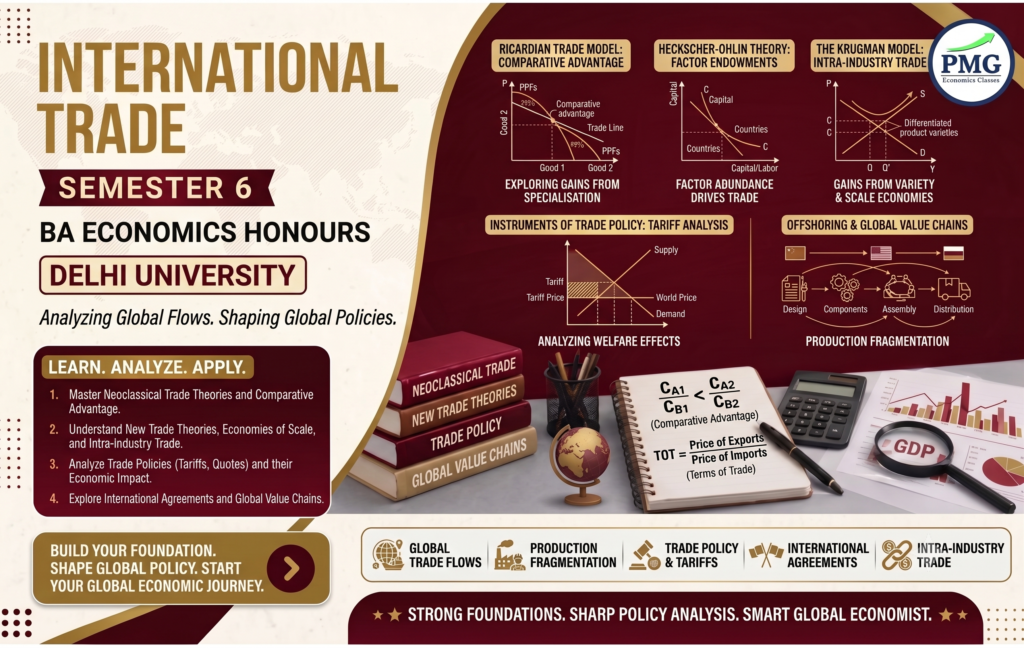
Ricardian Trade Theory: You will study the notion of comparative advantage and the gains from trade due to specialisation. It explains why a country should produce and export goods it can produce relatively more efficiently.
Specific Factor Model: This explores the international movement of factors and the standard trade model, analyzing how trade affects the earnings of specific factors of production (like land or capital).
Heckscher-Ohlin Theory: A crucial mathematical model explaining how factor endowments (labor vs. capital abundance) drive global trade patterns.
Factor Price Equalisation Theorem: Understanding how trade in goods can lead to the equalization of factor prices (like wages and rents) across different countries.
Rybczynski and Stolper-Samuelson Theorems: Advanced theorems detailing the complex relationship between relative prices of output, factor prices, and changes in national endowments.
Unit 2: New Trade Theories
Moving beyond classical models, this unit addresses why countries with similar resources still trade extensively with one another.
Economies of Scale: Differentiating between external and internal economies of scale and understanding how mass production influences global trade.
The Krugman Model: Introduced by Nobel laureate Paul Krugman, this model explains intra-industry trade (e.g., why Germany and Japan sell cars to each other).
Firm Heterogeneity: Analysing why only certain highly productive firms engage in international trade while others remain strictly domestic.
Multinational Firms and FDI: An introduction to the theory of Foreign Direct Investment and why corporations establish manufacturing operations overseas.
Offshoring of Goods and Services: Understanding the economics behind the global fragmentation of supply chains and international outsourcing.
Unit 3: Trade Policy
This unit shifts focus to government intervention and the real-world regulations governing international trade.
Instruments of Trade Policy: A deep dive into the mechanics and economic impact of tariffs, import quotas, export subsidies, and voluntary export restraints.
The Economics of Trade Policy: Analysing the welfare effects, deadweight loss, and the net national impact of protectionist policies.
Political Economy of Trade Policy: Exploring why governments often enact protectionist policies despite the known aggregate benefits of free trade.
International Agreements: Studying the role of the World Trade Organization (WTO), preferential trade agreements, and the complex intersection of trade, labor standards, and environmental sustainability.
[Read Our Detailed Guide On Career Options After BA Economics Honours]
Why is International Trade Important?
This subject forms the capstone of the BA Economics Honours program. After studying Microeconomics and Macroeconomics in your earlier semesters, International Trade brings all those concepts together on a global stage. Almost every advanced Economics Career relies heavily on these principles.
A strong understanding of Semester 6 International Trade also helps in:
Higher Studies in Economics: It is heavily tested in every major MA Economics entrance examination across the country.
Competitive Examinations: It forms a core component of the UPSC Economics optional syllabus and the Indian Economic Service (IES).
RBI and Banking Examinations: Crucial for understanding Balance of Payments, foreign exchange, and global financial health.
Corporate Placements: Essential for Economics Graduates aiming for lucrative Economics Jobs in international consulting, trade analysis, and multinational corporate strategy.
Public Policy: Developing the analytical toolkit needed to advise governments on export-import policies and international treaties.
[Read out Detailed Guide on Economist Salary in India]
Best Strategy to Score High in DU International Trade
Scoring a high GPA in your final semester requires a strategic approach. Rote memorization will not work here. Here are expert preparation tips to excel:
Understand the Concepts and Intuition Avoid memorizing definitions or theorem statements blindly. Focus on the underlying economic reasoning. For example, understand why a tariff creates a deadweight loss before trying to memorize the mathematical formula. Focus on intuition.
Master the Graphs and Diagrams Graphs are the absolute language of International Trade. Your university examination papers will heavily penalize you if your graphs are missing or incorrectly labeled. The Heckscher-Ohlin model, offer curves, and tariff impact diagrams are critical. Practice drawing them neatly, ensuring you clearly label the axes and show the direction of curve shifts using arrows.
Practice Numerical Questions A significant portion of your exam will involve solving numerical problems related to comparative advantage, terms of trade, and the welfare effects of quotas. Practicing these calculations will secure easy marks and demonstrate a deep understanding of the models.
Solve Previous Year Question Papers (PYQs) Past papers help you understand the university’s testing pattern. You will quickly notice that the derivation of the Stolper-Samuelson theorem, Krugman’s model of intra-industry trade, and the welfare analysis of tariffs are repeatedly asked.
Revise Regularly International Trade is highly interconnected. The concepts you learn in Unit 1 will directly apply to the policy discussions in Unit 3. Regular revision helps retain concepts and improves your ability to synthesize answers during the high-pressure final exam.
[Read Our Detailed Guide on Can Economics Graduates Get Jobs in Finance Industry?]
Common Examination Topics
Students should prepare these topics thoroughly for their university exams:
Ricardian Model of Comparative Advantage
Heckscher-Ohlin Theorem and its assumptions
Stolper-Samuelson and Rybczynski Theorems
Leontief Paradox
Internal vs. External Economies of Scale (Krugman Model)
Impact of Tariffs (Partial and General Equilibrium analysis)
Import Quotas vs. Tariffs
Political Economy of Protectionism
Foreign Direct Investment (FDI) and Offshoring
The role of the WTO and International Trade Agreements
[Read Our Detailed Guide on RBI Grade B Preparation After MA Economics]
Recommended Books
While your university reading list and class notes are your primary resources, the following textbooks are universally recommended for building an unshakeable foundation in this subject:
Paul Krugman, Maurice Obstfeld, and Marc Melitz – International Economics: Theory and Policy: This is the absolute gold standard for understanding modern trade theory, especially the Krugman model and firm heterogeneity.
Giancarlo Gandolfo – International Trade Theory and Policy: Highly recommended for a more mathematically rigorous treatment of the classical and neoclassical models.
Dominick Salvatore – International Economics: Excellent for conceptual clarity, detailed graphs, and student-friendly explanations of complex theorems.
Robert C. Feenstra and Alan M. Taylor – International Economics: Great for understanding offshoring, FDI, and real-world empirical examples.
Students should heavily rely on their official DU reading list for specific chapter references.
[Read Our Detailed Guide on Introductory Development Economics]
Frequently Asked Questions (FAQs)
Is International Trade in Semester 6 difficult? It can be challenging because it requires you to apply the microeconomic and macroeconomic concepts you learned in previous semesters to complex global scenarios. However, with consistent practice, strong graph-drawing skills, and the right Economics Tuition, it becomes highly logical and manageable.
How important is Semester 6 International Trade for MA Economics Entrance? It is incredibly important. The foundational models you learn here—especially Heckscher-Ohlin, comparative advantage, and trade policy—form a massive portion of the syllabus for DSE Economics, IIT JAM Economics, and CUET PG Economics.
Are class notes enough to score an O grade in DU Economics Honours? While class notes are great for revision, you must supplement them with core textbooks (like Krugman or Salvatore) and practice previous year numerical questions extensively to secure top grades.
What are the best career options after mastering International Trade? Students who excel in global trade analysis are highly preferred for Economics Honours Career paths in public policy, international think tanks, export-import management, and multinational Investment Banking.
Can a BA Programme student crack the MA Economics entrance? Yes. While Honours students have a specialized syllabus, BA Programme with Economics students who dedicate time to self-study, build their mathematical foundation, and join a structured Economics Entrance Coaching program frequently crack top entrances like CUET and IGIDR.
[Read our Detailed Guide on Can BCom Students do MA in Economics]
Why Choose PMG Classes for Economics Coaching Delhi?
If you are a student aiming for academic excellence, PMG Classes is widely recognized as the premier destination for BA Economics Honours coaching and the Best MA Economics Coaching in the city. Led by PMG SIR, we don’t just teach the syllabus; we build a lifelong conceptual foundation for your Economics Career.
Here is how we support our students:
Comprehensive Semester 6 Notes: Exhaustive study material, PYQ solutions, and structured reading resources specifically tailored to the DU syllabus.
Concept-Based Learning: We break down intricate trade models and mathematical theorems into highly digestible components.
Online and Offline Economics Classes: We offer both immersive classroom teaching in Delhi and highly interactive live virtual Online Economics Classes for outstation students.
Weekly Doubt Sessions: Dedicated time to clear any confusion regarding complex topics like the Rybczynski theorem or the Krugman model.
Mock Tests & Previous Year Question Practice: Regular assessments that simulate real university exams to build your time management and graph-drawing skills.
Elite MA Economics Entrance Preparation: We provide rigorous, targeted coaching for the most competitive exams in the country, including DSE, IIT JAM, ISI, and CUET PG Economics.
Career & Interview Guidance: Dedicated support for securing top Economics Jobs, navigating corporate placements, and higher education mentoring.
Whether you are preparing for your final semester examinations or gearing up for a Master’s degree, our structured approach helps you build the ultimate ecosystem for success.
[Read Our Detailed Guide on Economics Honours Syllabus]
Final Thoughts
International Trade is the grand finale of your undergraduate Economics Degree. It shifts your perspective from domestic markets to the global economy, giving you the analytical tools necessary to understand the world’s most pressing financial, diplomatic, and policy issues.
A solid grasp of comparative advantage, economies of scale, and trade policy will not only help you secure top grades in your university exams but will also act as the bedrock for your future postgraduate entrance preparations and corporate placements. As you prepare to transition from a student to an active participant in the global workforce, this subject provides the lens through which you will view the world.
If you are looking for Delhi University Economics Honours Semester 6 International Trade notes, classes, study material, PYQs, or expert Economics Coaching Delhi, explore our resources at PMG Classes and start preparing with confidence. Do not wait until the last minute—build your foundation today!
Connect With Us Real-Time
Ready to transform your grades? Reach out to PMG Classes today and let our experts guide you to academic excellence!
Phone: +91 9899312641
Email: manojgargeco@gmail.com
- Course Fees & Batch Timings: Please contact us directly for the latest batch schedules and detailed fee structures.