Economics has always been about understanding data.
From studying inflation and unemployment to analysing consumer behaviour, predicting demand, and evaluating government policies, economists constantly work with numbers and information.
But the way economic data is being created and analysed is changing rapidly.
Businesses, governments, financial institutions, and research organisations now have access to enormous amounts of data. As a result, simply understanding economics is no longer the only skill that can give students an advantage.
For Economics students, learning Data Science can open the door to a much wider range of opportunities.
But does that mean an Economics student needs to become a full-fledged data scientist?
Not necessarily.
The real advantage lies in combining economic thinking with data skills.
What Exactly Is Data Science?
Data Science is the process of using data, statistics, programming, and analytical techniques to extract useful insights and support decision-making.
It can involve:
- Collecting and cleaning data
- Analysing large datasets
- Finding patterns and trends
- Building statistical models
- Creating data visualisations
- Making predictions
- Using programming tools such as Python or R
- Communicating insights through reports and dashboards
At first glance, this might sound very different from Economics.
In reality, the two fields overlap considerably.
Why Do Economics and Data Science Work So Well Together?
Think about what an Economics student already learns.
Microeconomics teaches students how people and firms make decisions.
Macroeconomics explains economic growth, inflation, unemployment, and other large-scale economic phenomena.
Statistics teaches students how to interpret data.
Econometrics teaches students how to use statistical methods to investigate economic relationships.
Data Science builds on many of these ideas by adding programming, computational methods, and modern data-analysis techniques.
This creates a powerful combination:
Economics tells you what to investigate.
Data Science helps you analyse the information.
Economic reasoning helps you understand what the results actually mean.
Why Is This Combination Becoming More Valuable?
Imagine a company wants to understand why sales have fallen.
A data analyst might identify patterns in sales figures, customer behaviour, locations, and pricing.
An Economics student with data skills can go a step further and think about questions such as:
- Has the price changed?
- Has consumer income changed?
- Are customers responding differently to competitors?
- Has demand become more price-sensitive?
- Is the decline seasonal?
- Are there changes in consumer preferences?
The technical analysis becomes much more useful when it is combined with economic reasoning.
That is where Economics students can have an advantage.
Data Is Everywhere in Economics
Modern economic decisions increasingly depend on data.
Consider the number of areas where economic data is used:
Government
Governments analyse data to understand employment, inflation, poverty, consumption, taxation, and economic growth.
Banking and Finance
Financial institutions use data for risk analysis, forecasting, customer behaviour, credit decisions, and market research.
Businesses
Companies analyse consumer behaviour, pricing, sales, demand, and competition.
Consulting
Consulting firms use data to help businesses and organisations solve complex problems.
Research
Universities and research institutions use large datasets to study economic and social issues.
This means data skills can be useful across a wide variety of careers.
Do Economics Students Need to Learn Coding?
This is one of the biggest questions students have.
The answer is:
Learning basic programming can be extremely useful, but you don’t need to become a software engineer.
For an Economics student, the objective is not necessarily to build the next social media platform.
Instead, programming can help automate repetitive tasks and analyse datasets more efficiently.
For example, Python can be used to:
- Clean datasets
- Perform statistical analysis
- Create graphs
- Automate repetitive calculations
- Analyse large amounts of information
- Build simple predictive models
Even basic programming knowledge can make an Economics student more comfortable working with data.
Which Tools Should Economics Students Learn?
Students don’t need to learn every tool available.
A practical learning path could be:
1. Excel
Start here.
Excel remains extremely useful for organising, analysing, and presenting data.
Students should become comfortable with formulas, pivot tables, charts, filtering, and basic data analysis.
2. Statistics
Strong statistical fundamentals are essential.
Understanding concepts such as probability, distributions, correlation, regression, and hypothesis testing makes it much easier to understand advanced data techniques.
3. Econometrics
Econometrics is particularly valuable because it teaches students how to use data to investigate economic relationships.
A strong foundation in econometrics can make the transition into data analytics much easier.
4. Python or R
Students can then learn a programming language.
Python is widely used for data analysis and has a large ecosystem of libraries for working with data.
R is also highly relevant, particularly in statistics, research, and econometrics.
Students don’t necessarily need to master both immediately.
Start with one and build strong fundamentals.
5. Data Visualisation
Being able to analyse data is only half the job.
You also need to communicate what the data is telling you.
Charts, dashboards, and clear visualisations can turn complicated analysis into something decision-makers can understand.
What Career Opportunities Can This Combination Create?
Learning Data Science alongside Economics can broaden a student’s career options.
Data Analyst
Data analysts examine datasets to identify trends and provide insights that help organisations make decisions.
Economic Analyst
Economic analysts use economic data and models to study markets, industries, policies, and broader economic trends.
Business Analyst
Business analysts combine analytical thinking with business knowledge to identify problems and improve decision-making.
Financial Analyst
Financial analysts evaluate financial information, markets, companies, and investment-related data.
Research Analyst
Research analysts collect and analyse information to answer specific research questions.
Policy Analyst
Policy analysts evaluate economic and social data to understand the potential effects of different policies.
Data-Driven Consulting
Consulting increasingly involves using data to solve business and economic problems.
An Economics graduate with strong analytical skills can potentially bring both domain knowledge and quantitative ability to these roles.
Economics Students Have One Important Advantage
There is something that students sometimes overlook.
Data Science can teach you how to analyse data.
Economics can teach you how to think about economic problems.
Knowing how to use Python or build a model is valuable.
But knowing which question to ask in the first place is equally important.
For example, a model might show a strong relationship between two variables.
An economically trained student is more likely to ask:
Does this relationship make economic sense?
Could another factor be causing it?
Is this correlation or causation?
What assumptions does the model make?
What would happen if the economic environment changed?
These questions are crucial when turning data into meaningful conclusions.
How Can Students Start?
You don’t need to learn everything simultaneously.
A simple roadmap could look like this:
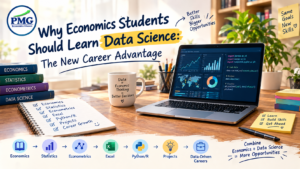
Economics → Statistics → Econometrics → Excel → Python/R → Data Visualisation → Projects
The most important part is practice.
Instead of only watching tutorials, students should work on small projects.
For example:
- Analyse inflation trends in India
- Study unemployment data
- Compare GDP growth across countries
- Analyse consumer price trends
- Study the relationship between education and income
- Create a dashboard using economic indicators
Projects allow students to demonstrate that they can actually use their knowledge.
Is Data Science Worth Learning Alongside Economics Honours?
For students interested in analytical, research, finance, consulting, business, or policy careers, yes, it can be a very useful addition.
But students shouldn’t feel pressured to abandon Economics for Data Science.
The goal is not:
Economics OR Data Science
It is:
Economics + Data Science.
That combination can help students understand both the problem and the data behind the problem.
The Future Is Not About Choosing One Field
The boundaries between academic disciplines are becoming less rigid.
Economics increasingly uses computational tools.
Business increasingly relies on data.
Finance increasingly depends on quantitative analysis.
Government increasingly uses large datasets for policy decisions.
And research is becoming more data-intensive.
This means students who can work across disciplines may have an advantage.
An Economics student who understands data can speak the language of economists and the language of data professionals.
That can be a powerful combination.
Final Takeaway
Data Science shouldn’t be seen as a replacement for Economics.
Instead, it can be viewed as a career-enhancing skill for Economics students.
Economic theory helps students understand markets, incentives, behaviour, and policies.
Statistics and econometrics help them reason with evidence.
Data Science gives them additional tools to work with increasingly large and complex datasets.
Together, these skills can make an Economics graduate more adaptable to a changing job market.
So if you’re an Economics student wondering what skill to add to your degree, don’t ask:
“Should I choose Economics or Data Science?”
Ask:
“How can I use Data Science to become better at Economics?”
That may be the more valuable question for the future.
How Can Data Science Actually Make You a Better Economics Student?
Learning Data Science isn’t just about adding another skill to your CV. For an Economics student, it can actually change the way you study, research, analyse, and understand economic problems.
1. You Can Work With Real Economic Data
Economics textbooks often use simplified examples. Real-world economic data is much messier.
With Data Science skills, students can work with actual datasets and explore questions such as:
- How has inflation changed over the last decade?
- What factors are associated with unemployment?
- How does income affect consumption?
- How has India’s GDP changed over time?
- Are there differences in economic growth between states or countries?
Instead of only reading about these concepts, students can test them using real data.
2. You Can Understand Econometrics Better
Econometrics can sometimes feel intimidating because it combines economics, mathematics, and statistics.
Data Science can make it more practical.
When students learn how to clean data, visualise relationships, run regressions, and interpret results using software, concepts that seem theoretical in class can become much easier to understand.
For example, instead of simply learning the concept of regression from a textbook, a student can actually use a dataset to investigate whether education is associated with higher income.
This creates a stronger connection between economic theory and evidence.
3. You Can Turn Numbers Into Stories
A spreadsheet can contain thousands of numbers, but numbers alone don’t always communicate an idea effectively.
Data visualisation helps Economics students turn complicated information into something people can understand.
A well-designed graph can show:
- Inflation trends
- GDP growth
- Income inequality
- Employment patterns
- Changes in demand
- Market trends
This is an important professional skill because economists don’t just analyse information—they also need to communicate their findings clearly.
4. You Can Test Economic Ideas
One of the biggest advantages of combining Economics with Data Science is the ability to move from:
“I think this happens…”
to
“Let’s examine the data and find out.”
Suppose economic theory suggests that an increase in price may reduce demand.
A student with Data Science skills can work with relevant data, visualise the relationship, build a model, and investigate whether the evidence supports the theoretical expectation.
This encourages students to think like researchers rather than just learners.
5. You Can Build Better Projects
Data-driven projects can make an Economics student’s academic portfolio much stronger.
Instead of submitting only theoretical assignments, students can create projects such as:
“What Drives Inflation in India?”
“Does Education Increase Earnings?”
“How Does Unemployment Change During Economic Slowdowns?”
“Comparing GDP Growth Across Indian States.”
These projects can combine economic theory, statistical analysis, programming, and visualisation.
And importantly, they give students something concrete to show employers or universities.
A Simple Skill Combination for Economics Students
Students don’t need to become experts in every technical field.
A strong combination could be:
Economic Theory
↓
Statistics
↓
Econometrics
↓
Excel
↓
Python / R
↓
Data Visualisation
↓
Real-World Projects
This combination creates something much more valuable than simply knowing individual tools.
It creates the ability to understand an economic problem, analyse evidence, and communicate the result.
What Should an Economics Student Learn First?
If you’re starting from zero, don’t try to learn Python, machine learning, statistics, and everything else at once.
Start with the fundamentals.
Phase 1 — Strengthen Economics
Make sure your foundations in Microeconomics, Macroeconomics, Statistics, and Econometrics are strong.
Phase 2 — Become Comfortable With Data
Learn Excel and understand how datasets are structured.
Phase 3 — Learn Programming
Start with Python or R and focus specifically on data analysis rather than trying to learn programming as an entire field.
Phase 4 — Apply It to Economics
This is where the real value appears.
Use your new skills to analyse economic questions, rather than working on random datasets simply to practise coding.
Phase 5 — Build a Portfolio
Create a few well-documented projects that demonstrate how you used data to answer an economic question.
The Biggest Mistake Students Should Avoid
Learning Data Science just because “everyone is learning it” isn’t enough.
A student can complete ten coding courses and still struggle to solve a real economic problem.
The goal should not be to collect certificates.
The goal should be to develop problem-solving ability.
Instead of asking:
“Which programming language should I learn?”
Ask:
“What economic problem can I solve using this skill?”
That change in thinking can make your learning much more meaningful.
Economics Gives Data Science Context
There is also another side to this combination that students often overlook.
Data Science can tell you what the data is showing.
Economics can help you understand why it might be happening.
Imagine a dataset shows that a particular group has significantly lower employment rates.
A purely technical analysis may identify the pattern.
An Economics student can start investigating:
- Incentives
- Education
- Wages
- Labour-market conditions
- Government policies
- Demographic factors
- Demand and supply
This is where economic reasoning becomes extremely valuable.
Data gives you evidence. Economics gives you a framework for interpreting that evidence.
So, What Does the Future Look Like?
The future of Economics isn’t about economists becoming programmers.
Nor is it about Data Scientists replacing economists.
It is about the increasing overlap between economic knowledge and analytical technology.
The Economics students who learn to work with data will be better prepared to deal with a world where decisions are increasingly based on information.
And the students who can combine:
Economic Thinking + Statistical Reasoning + Data Skills
may have an especially valuable combination of abilities.
Final Takeaway
Data Science shouldn’t be treated as something completely separate from Economics.
For an Economics student, it can become a tool for asking better questions, analysing real-world evidence, understanding econometrics, conducting research, and making stronger decisions.
You don’t need to choose between being an Economics student and becoming technically skilled.
You can become both.
So instead of asking:
“Should I choose Economics or Data Science?”
Ask:
“How can I use Data Science to become better at Economics?”
That may be the more valuable question for the future.
And for today’s Economics students, the answer could be the beginning of a much broader career path.