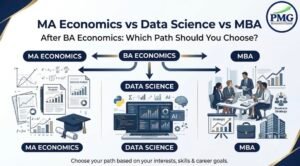
Completing a BA Economics or BA Economics Honours degree can feel like reaching the end of one journey and suddenly standing in front of several completely different roads. During school, the decision may have been as simple as choosing Economics as a subject or selecting an undergraduate degree. But once graduation approaches, the questions become much more complicated. Should you continue studying Economics and pursue an MA Economics? Should you move into the rapidly growing world of Data Science? Or would an MBA give you better opportunities in business, consulting, finance and management?
There is no shortage of advice available to students at this stage. One person may tell you that an MA Economics is the natural choice because you already have a degree in Economics. Another may say that Data Science is the future and that every Economics graduate should learn coding. Someone else may recommend an MBA because it offers access to corporate careers, management roles and potentially strong placements. The problem is that all three statements can sound convincing, especially when you are trying to make a decision about the next two or three years of your life.
The reality is much more interesting. MA Economics, Data Science and MBA are not simply three different degrees competing with each other. They lead students towards different kinds of work. An MA Economics generally takes you deeper into economic theory, mathematics, econometrics, research, policy and economic analysis. Data Science takes you towards statistics, programming, databases, machine learning, data analysis and technology-driven decision-making. An MBA takes you closer to business, management, strategy, finance, marketing, operations, consulting and leadership.
Therefore, the better question is not “Which degree is best?” The better question is, “What kind of professional do I want to become after my BA Economics?”
That one question can completely change your decision.
A student who enjoys understanding inflation, unemployment, monetary policy, markets, economic models and econometrics may find MA Economics far more meaningful than an MBA. A student who enjoys working with datasets, Python, statistics, programming and predictive models may discover that Data Science is the better direction. A student who enjoys business decisions, presentations, leadership, strategy, marketing, finance and working with organisations may find an MBA more suitable.
Your BA Economics degree gives you something valuable: flexibility. Economics is connected to business, finance, government, data, markets, public policy and research. That means graduation does not force you into one career. Instead, it gives you a foundation from which you can specialise.
This article will help you understand what each path actually involves, what kind of student should choose it, what skills you will need, what careers can follow, what mistakes students commonly make and, most importantly, how you can create a practical roadmap from BA Economics to your chosen career.
First Understand What Your BA Economics Degree Has Already Given You
Before comparing MA Economics, Data Science and MBA, it is important to understand the foundation you already have.
A good Economics degree is not simply about memorising definitions of inflation, GDP, demand and supply. Students studying Economics encounter mathematical methods, statistics, microeconomics, macroeconomics, econometrics and economic reasoning. Depending on the university and programme, students may also study development economics, public economics, international economics, financial economics and the Indian economy.
This combination is important because Economics sits at the intersection of theory, mathematics, data and real-world decision-making.
When you study microeconomics, you learn to think about how consumers and firms make decisions. When you study macroeconomics, you begin understanding inflation, unemployment, economic growth, interest rates and government policy. Statistics helps you understand data, while econometrics teaches you how economic theories can be examined using real-world information.
That is why Economics graduates can move into several areas instead of remaining restricted to traditional “economist” jobs. PMG Classes’ existing career guidance similarly highlights opportunities across analytics, finance, consulting, banking, research and public policy. (PMG CLASSES)
But there is an important catch.
A degree gives you academic knowledge. The job market also expects practical skills.
For example, two students may graduate with the same BA Economics degree. One may know Excel, SQL, Python, data visualisation, econometrics and financial modelling and may have completed two internships. The other may have only studied for university examinations and never worked on a practical project.
Their degrees are identical, but their professional profiles are completely different.
This is why your decision after BA Economics should not simply be about choosing another degree. It should be about deciding what combination of education and skills will make you employable for the career you want.
The Three Paths in Simple Language
Think about the three options in the following way.
MA Economics asks you to go deeper into Economics.
Data Science asks you to go deeper into data, statistics and technology.
MBA asks you to move from understanding economic and business problems towards managing and solving business problems.
An MA Economics student may spend considerable time studying advanced microeconomics, macroeconomics, econometrics, mathematical economics and economic theory. The course can become significantly more quantitative than undergraduate Economics. PMG’s own explanation of BA versus MA Economics highlights the greater emphasis on calculus, optimisation, statistics, econometrics, modelling and quantitative problem-solving at the postgraduate level. (PMG CLASSES)
A Data Science student may spend more time learning programming, statistics, databases, machine learning, data cleaning, data visualisation and predictive modelling. Economics can become the domain knowledge that helps the student understand why the numbers matter.
An MBA student may spend more time understanding organisations and business decisions through areas such as finance, marketing, operations, strategy, human resources and business analytics.
None of these is automatically superior.
They simply build different professional identities.
MA Economics: What Does It Actually Mean?
If you genuinely enjoy Economics, an MA Economics can be one of the most logical postgraduate choices after a BA Economics degree.
However, students should not think of MA Economics as simply “BA Economics continued for two more years.”
The level and approach can be considerably different.
At undergraduate level, you may learn a concept and use mathematical tools to understand it. At postgraduate level, you may be expected to understand the assumptions behind the model, derive relationships mathematically, interpret econometric results and think critically about whether a particular economic framework explains a real-world problem.
The mathematics can therefore become more serious.
This is particularly important for students considering reputed Economics postgraduate programmes. A student who enjoys Economics but strongly dislikes mathematics, statistics and quantitative analysis should understand this reality before choosing an MA.
That does not mean you need to be a mathematical genius.
It means you need to be willing to improve.
Algebra, calculus, probability, statistics, optimisation and econometrics become important foundations for advanced Economics. Students who build these foundations during their undergraduate years generally find the transition more manageable. (PMG CLASSES)
Who Should Choose MA Economics?
MA Economics is particularly suitable for students who enjoy asking questions such as why inflation changes, how monetary policy affects an economy, why unemployment exists, how firms behave, why markets fail, how economic policies affect households, or how development differs across countries.
It is also a strong option if you are interested in economic research, policy analysis, academia, teaching, banking, financial analysis, economic consulting or advanced quantitative work.
For example, imagine that you read about the Reserve Bank changing interest rates.
A student interested in MA Economics may immediately start thinking about inflation, monetary transmission, investment, consumption, exchange rates and economic growth.
That curiosity is a good sign.
If instead your first thought is, “Can I use a dataset to predict how consumers will respond to this change?”, you may also have a strong interest in Data Science.
And if your first thought is, “How will this affect a company’s strategy, sales and profitability?”, you may naturally be drawn towards business and an MBA.
The difference is not about intelligence.
It is about the type of problems you enjoy solving.
What Careers Can Follow MA Economics?
An MA Economics can lead to careers in economic research, policy analysis, financial analysis, banking, consulting, analytics, research organisations, think tanks, government-related work and academia.
Students can also explore specialised careers in financial markets, economic consulting, public policy and research.
For certain government and specialist economic roles, postgraduate Economics qualifications can also be important. Students interested in becoming professional economists should understand the eligibility requirements of specific organisations and examinations rather than assuming that every Economics job requires the same qualification. PMG’s economist career guidance similarly explains that a bachelor’s degree provides the foundation, while higher studies, skills and practical experience can become important for specialised economist careers. (PMG CLASSES)
An MA Economics also does not prevent you from learning technology.
In fact, one of the strongest modern profiles can be Economics plus data skills.
You can study advanced Economics while learning Python, R, SQL, Excel and data visualisation. This can make your profile useful not only for traditional economic research but also for analytics, finance and data-oriented roles.
This is an important point for students who think they have to choose between Economics and technology.
You do not always have to.
The Mathematics Question: Should You Be Afraid of MA Economics?
This is one of the biggest concerns among Economics students.
The honest answer is that mathematics matters.
But “mathematics matters” does not mean “only brilliant mathematicians can study Economics.”
If you are willing to practise, you can improve.
The bigger problem is avoiding mathematics completely during your BA and then expecting to handle advanced Economics comfortably later.
Students planning for MA Economics should gradually become comfortable with algebra, functions, differentiation, optimisation, probability, statistics and basic econometrics.
Instead of treating mathematics as something separate from Economics, try to understand why it is being used.
For example, optimisation is not introduced simply to make Economics difficult. It helps economists model choices such as how consumers maximise utility or how firms maximise profit.
Similarly, statistics is not merely a collection of formulas. It provides the tools needed to understand uncertainty and data.
Once you understand the purpose, the mathematics becomes less intimidating.
Data Science: Why Is It Attracting Economics Students?
Data Science has become particularly attractive to Economics students because the two fields already have an important connection.
Economics uses data.
Economists study employment data, inflation, income, prices, consumption, business performance, financial markets and economic growth. Econometrics provides statistical tools for analysing relationships in economic data.
Data Science takes this data-oriented thinking much further by adding programming, databases, machine learning and modern computational methods.
This is why Economics and Data Science can make a powerful combination.
PMG Classes’ existing article on Economics and Data Science describes the combination as particularly relevant for careers in finance, business analytics, consulting, banking, technology, research and data-driven decision-making. (PMG CLASSES)
But students should understand one important difference.
Knowing Economics does not automatically make you a Data Scientist.
If you want to enter Data Science, you need to develop the technical side seriously.
What Does a Data Scientist Actually Do?
At a basic level, a Data Scientist works with data to find patterns, build models and help organisations make better decisions.
But real Data Science is much more than making attractive graphs.
A data professional may need to collect or access data, clean it, understand missing values, explore patterns, perform statistical analysis, build models, test their performance and explain the results to other people.
Programming therefore becomes important.
Python is widely used for data analysis and machine learning. SQL is important for working with databases. Statistics provides the mathematical foundation for understanding data. Data visualisation helps communicate results.
Machine learning can then be used for tasks such as prediction, classification, recommendation and pattern recognition.
For an Economics student, this creates an interesting opportunity.
You already understand an important part of the problem.
Suppose a company wants to understand why customers are leaving.
A purely technical approach may focus on building a prediction model.
An Economics student may additionally ask about incentives, prices, consumer behaviour, income, competition and market conditions.
That combination can be valuable.
Should Every Economics Student Learn Data Science?
No.
Every Economics student should develop some comfort with data, but that does not mean everyone needs to become a full-fledged Data Scientist.
There is a difference between learning data skills and choosing Data Science as a career.
For almost any modern Economics career, Excel and basic data analysis can be useful. SQL can become valuable for analytics roles. Python or R can be extremely useful for econometrics and research.
But if you want to become a professional Data Scientist, you need to go considerably further into programming, statistics and machine learning.
This distinction prevents another common mistake.
Students sometimes complete a short Python course and immediately write “Data Scientist” on their résumé.
Learning Python is a beginning, not a professional qualification.
Who Should Choose Data Science After BA Economics?
Data Science may be a strong choice if you genuinely enjoy working with numbers, statistics, computers and datasets.
You should be comfortable spending time debugging code, cleaning messy data and trying to understand why a model is producing a particular result.
You should also be willing to learn continuously.
Technology changes quickly.
The tools that are popular today may evolve tomorrow. Therefore, Data Science rewards students who enjoy learning rather than students who simply want a degree with a fashionable job title.
If you enjoy Economics but increasingly find yourself more interested in data analysis than economic theory, Data Science can be worth serious consideration.
What Careers Can Follow Data Science?
Students with Economics and Data Science skills can explore careers in data analytics, business analytics, product analytics, financial analytics, risk analytics, market research, economic data analysis and, with sufficient technical preparation, Data Science and machine learning roles.
The exact role depends heavily on skill level.
A student with strong Excel and SQL may be suitable for an entry-level analytics position.
A student with strong Python, statistics, SQL, machine learning and project experience may target more advanced data roles.
A student with Economics, econometrics and programming may find opportunities in economic research and quantitative analysis.
Therefore, do not think of Data Science as one single career.
It is an ecosystem of related careers.
MBA After BA Economics: What Changes?
Now comes the third major option: MBA.
An MBA is fundamentally different from an MA Economics.
While MA Economics takes you deeper into economic analysis, an MBA takes you towards management and business decision-making.
You may study areas such as marketing, finance, operations, strategy, human resources, business analytics and organisational behaviour.
This does not mean that an MBA is “less analytical.”
A good MBA can involve considerable quantitative work, particularly in finance, operations, economics, statistics and analytics.
But the broader focus is different.
An Economics degree often asks, “How does this economic system behave?”
An MBA may ask, “How should this organisation respond?”
That distinction is useful.
Who Should Choose an MBA After Economics?
MBA can be an excellent option for students who enjoy business and want to work in corporate environments.
If you are interested in consulting, management, strategy, finance, marketing, operations, entrepreneurship or leadership, an MBA may align well with your interests.
For example, imagine a company is losing market share.
An Economics student may investigate market structure, consumer behaviour, pricing and competition.
A Data Scientist may analyse customer data and build models to identify patterns.
An MBA student may look at the entire business problem and ask whether the company needs a new pricing strategy, marketing strategy, product strategy, distribution model or organisational change.
In the real world, these approaches can overlap.
That is why Economics graduates can fit naturally into MBA programmes.
Does an MBA Automatically Mean a High Salary?
This is one of the most important myths students need to avoid.
An MBA is not a magic salary machine.
The outcome depends on the institution, programme quality, specialisation, internships, prior academic record, entrance performance, communication skills, work experience where relevant and the roles you target.
A student should therefore not choose an MBA simply because someone said, “MBA graduates earn more.”
The better question is whether the MBA will provide access to the type of career you actually want.
An MBA from a strong institution can open significant opportunities, but students should evaluate the programme carefully rather than selecting a college only because it uses the word “MBA.”
MA Economics vs Data Science vs MBA: The Real Comparison
The easiest way to understand the difference is to imagine three students.
Student A loves Economics.
She enjoys microeconomics, macroeconomics, econometrics and economic policy. She likes mathematical reasoning and wants to understand economic problems deeply. She may be interested in research, policy, banking or economic analysis.
For her, MA Economics is a natural option.
Student B enjoys Economics but becomes most excited when working with datasets. He likes statistics, Python, SQL and visualisation. He wants to work with technology and data-driven decision-making.
For him, Data Science or a strong Economics plus Data Analytics pathway may be more appropriate.
Student C enjoys Economics but is fascinated by business. She likes presentations, strategy, leadership, finance and understanding how companies operate.
For her, an MBA may be the stronger direction.
Notice something important.
All three students studied Economics.
Their next steps are different because their interests are different.
That is exactly why copying someone else’s career decision is dangerous.
Which Option Is More Difficult?
Students often ask which is easier: MA Economics, Data Science or MBA.
There is no universal answer.
The difficulty depends on your strengths.
A student who loves mathematics may find MA Economics challenging but enjoyable.
The same student may find an MBA’s presentations and group projects more uncomfortable.
A student who enjoys coding may find Data Science exciting while another student may find programming extremely frustrating.
A student who is naturally comfortable with communication, teamwork and presentations may enjoy an MBA but dislike advanced mathematical Economics.
The correct question is therefore not “Which course is easiest?”
It is “Which type of difficulty am I willing to work through?”
Every worthwhile career path has difficult parts.
What About Salary?
Salary is obviously important, but it should not be the first and only factor in this decision.
Salary varies dramatically based on institution, location, role, experience, skills, industry and performance.
An excellent Economics graduate with strong analytical and technical skills can outperform a poorly prepared MBA graduate.
A highly skilled Data Scientist can earn very well, but a student with weak programming skills should not choose Data Science simply because they have heard that Data Science pays well.
Similarly, an MBA from a strong institution can open excellent opportunities, but an MBA without strong career planning may not produce the outcome a student expects.
Think of the degree as an opportunity platform.
Your skills and performance determine how effectively you use that platform.
What About Placements?
Placements are another area where students need to be careful.
Do not compare degrees using only the highest package displayed on a college website.
Instead, understand the median or typical outcomes, the roles offered, the industries recruiting, the percentage of students placed, the quality of recruiters and the career paths students take after graduation.
A degree is not valuable simply because someone once received a very high package after completing it.
Look at the overall ecosystem.
This becomes especially important when comparing MBA programmes.
For Economics and Data Science programmes too, students should investigate where graduates actually work and what skills employers expect.
The Strongest Combination May Not Be One Degree
One of the biggest lessons for Economics students today is that career paths are becoming less rigid.
You do not necessarily have to choose:
Economics OR Data.
You can choose Economics + Data.
You do not necessarily have to choose:
Economics OR Business.
You can choose Economics + Business.
This is why an Economics graduate who learns Python, SQL, Excel, econometrics and financial analysis can create a powerful profile.
Similarly, an Economics graduate who completes an MBA and maintains strong quantitative skills can combine economic reasoning with management knowledge.
This combination mindset is becoming increasingly useful.
Economics + Data Science: A Particularly Strong Combination
For students who are genuinely interested in both Economics and technology, combining the two can be extremely useful.
Economics helps you understand the context.
Statistics helps you analyse uncertainty.
Econometrics connects economic theory and data.
Programming allows you to work with larger and more complex datasets.
Machine learning can help with prediction and pattern recognition.
Communication allows you to explain what the results mean.
This is much stronger than simply knowing how to run code.
Imagine that a machine learning model predicts that a particular group of customers is likely to stop using a service.
A technically trained person can explain the prediction.
An Economics-trained person may also ask why.
Could price be the reason?
Could income be relevant?
Is the market becoming more competitive?
Are customers responding to incentives?
Is the pattern actually causal or merely correlated?
This is where domain knowledge becomes valuable.
Economics + MBA: Another Strong Combination
Economics and management also complement each other.
Economics teaches students about incentives, markets, consumers, firms and economic conditions.
An MBA can add strategy, finance, marketing, operations and organisational knowledge.
This can be useful for careers in consulting, corporate strategy, financial management, business analytics and management.
Again, however, the combination only becomes valuable when the student actually develops the required skills.
An Economics graduate does not become a strong business professional simply by obtaining an MBA.
Internships, communication, analytical ability, teamwork and practical exposure matter.
Can You Do MA Economics and Learn Data Science?
Yes, and for some students this may actually be one of the best routes.
Suppose your primary interest is Economics, but you also recognise that modern economic work is increasingly data-driven.
You could pursue MA Economics while developing Python, SQL, R, Excel and data visualisation skills.
During your MA, you could work on projects involving economic datasets.
For example, you could analyse inflation trends, unemployment data, household consumption, financial markets, regional development or consumer behaviour.
This gives you a profile that is different from both a traditional Economics student and a purely technical Data Science student.
You become someone who understands both the question and the data.
A Practical Roadmap From BA Economics to MA Economics
If MA Economics is your goal, start by strengthening your undergraduate Economics foundation rather than waiting until graduation.
Microeconomics and macroeconomics should be conceptually clear. Mathematics should become comfortable enough that equations do not intimidate you. Statistics should be treated as a core skill rather than an examination subject. Econometrics should be understood instead of memorised.
As you approach final year, identify the entrance examinations and universities you want to target. Check their latest eligibility criteria, syllabus and examination pattern because these can change.
Then prepare systematically.
Do not study only the topics you like.
A common mistake is spending too much time on favourite areas while avoiding mathematics, statistics or econometrics.
Your goal should be balanced preparation.
PMG’s existing guidance similarly recommends building mathematics, statistics, econometrics and core Economics foundations progressively rather than waiting until the final year. (PMG CLASSES)
A Practical Roadmap From BA Economics to Data Science
If Data Science is your target, start before graduation.
First become comfortable with Excel and statistics.
Then learn SQL.
After that, learn Python properly rather than simply watching introductory videos.
You should understand variables, data structures, functions, libraries and basic programming logic. Then move into data analysis using tools such as pandas and visualisation libraries.
Once your foundation is strong, study probability and statistics more deeply.
After that, move towards machine learning.
Most importantly, build projects.
A certificate saying “Completed Data Science Course” is not as convincing as a project demonstrating that you can actually work with data.
As an Economics student, your projects should ideally connect your technical skills with Economics.
For example, you could analyse inflation data, study unemployment trends, examine stock-market relationships, investigate consumer spending or build a model using publicly available economic datasets.
This gives employers evidence of both technical ability and domain knowledge.
A Practical Roadmap From BA Economics to MBA
If you are considering an MBA, do not wait until graduation to think about entrance preparation.
First understand which MBA entrance examinations and institutions you want to target.
Then build your quantitative aptitude, logical reasoning, reading comprehension and communication skills according to the relevant examination.
At the same time, develop awareness of business and the economy.
Read business news.
Understand what companies do.
Follow major economic developments.
Learn how interest rates, inflation, exchange rates, taxation and government policies can affect businesses.
Internships can also help you understand whether you actually enjoy corporate work.
This is important because some students prepare for an MBA for years only to discover after entering the programme that they do not enjoy the business environment they imagined.
What Should You Do During Your BA Economics Degree?
Your undergraduate years are more important than many students realise.
You do not need to wait until graduation to decide everything.
In the first year, focus on building strong fundamentals. Understand Economics properly and become comfortable with mathematics and statistics. Learn Excel and improve your academic writing.
In the second year, start exploring your interests. Try basic Python or R if you are curious about data. Explore finance if you are interested in banking. Attend seminars and workshops. Try an internship if possible.
In the third or final year, your direction should become clearer. If you want MA Economics, intensify entrance preparation. If you want Data Science, build projects and technical skills. If you want an MBA, focus on entrance preparation, internships and business awareness.
If your degree follows a four-year structure, use the additional time strategically rather than simply treating it as another year of classroom study.
The objective should be to graduate with both a degree and a professional profile.
What If You Are Confused Between All Three?
Being confused is normal.
In fact, it may be healthier than choosing a degree simply because your friends are choosing it.
Try a small experiment.
Spend some time with each field.
Study an Economics topic beyond your university syllabus.
Try a basic data analysis project.
Watch or read introductory material about business strategy and management.
Notice what makes you curious.
Do you enjoy understanding theories and economic models?
Do you enjoy working with data and code?
Do you enjoy discussing businesses, strategies and organisational decisions?
Your response can tell you more than a random career quiz.
A Simple Decision Framework
If you enjoy Economics itself and want deeper theoretical, quantitative and analytical knowledge, MA Economics should be near the top of your list.
If you enjoy numbers but want to move towards programming, technology, analytics and machine learning, Data Science deserves serious consideration.
If you enjoy business, leadership, strategy, finance, consulting and management, an MBA may fit your personality and career goals better.
If you enjoy two of these areas, do not automatically eliminate one.
Instead, look for combinations.
Economics + Data Science can be powerful.
Economics + MBA can also be powerful.
MA Economics + Data Analytics can be powerful.
The strongest profile is often not created by choosing the most fashionable degree. It is created by combining your academic background with skills that employers actually need.
What If You Want Finance?
Finance is one area where all three routes can potentially lead.
An MA Economics can help you understand markets, monetary policy, econometrics and economic conditions.
Data Science can help with financial analytics, risk modelling and data-driven decision-making.
An MBA, particularly with a relevant specialisation, can help with corporate finance, management, consulting and business roles.
Your choice should therefore depend on the type of finance career you want.
Someone interested in economic research around financial markets may prefer Economics.
Someone interested in quantitative analytics may prefer Data.
Someone interested in corporate finance and management may prefer an MBA.
Again, the job title matters more than the degree name.
What If You Want Consulting?
Consulting is another area where Economics graduates can fit well.
Economics teaches analytical thinking and problem-solving. Data skills can strengthen your ability to work with evidence. An MBA can provide additional business and management knowledge.
Therefore, there is no single mandatory route.
What matters is whether you can structure problems, analyse information, communicate clearly and make practical recommendations.
If consulting is your goal, develop communication alongside quantitative skills.
Being able to calculate an answer is not enough.
You must be able to explain what the answer means.
What If You Want Research or Policy?
If your interest lies in research, government policy, development economics or economic analysis, MA Economics becomes particularly relevant.
You should strengthen econometrics, statistics, research methodology and academic writing.
Learning data tools is also increasingly useful because modern policy research depends heavily on data.
Public policy is no longer simply about reading government reports.
Researchers increasingly work with large datasets and quantitative evidence.
Therefore, Economics plus data skills can again become a powerful combination.
What If You Want a Career in Technology?
If technology genuinely excites you, Data Science may be worth exploring seriously.
However, understand that technology careers reward demonstrated skills.
You cannot depend only on your Economics degree.
Learn programming.
Work with datasets.
Build projects.
Understand statistics.
Learn SQL.
Develop machine learning knowledge if you want to move in that direction.
Your Economics background can become an advantage because you can specialise in areas such as financial data, economic forecasting, consumer analytics or business analytics.
The Role of AI in Your Career Decision
Students today are making career decisions in a different environment from students five or ten years ago.
Artificial Intelligence is changing how organisations work.
Some repetitive analytical tasks can increasingly be automated. At the same time, demand is growing for people who can understand problems, work with data, use technology and interpret results responsibly.
This does not mean Economics is becoming irrelevant.
It also does not mean everyone should become a Data Scientist.
Instead, it means students should develop the ability to work alongside technology.
For an Economics student, this could mean learning how to use AI tools for research, coding assistance, data exploration, writing and productivity while still understanding the underlying Economics and statistics.
The important principle is simple:
Do not compete with technology on tasks that technology performs better.
Learn to use technology to become better at the tasks that require judgement, interpretation and problem-solving.
Common Mistakes Students Make After BA Economics
One of the biggest mistakes is choosing a degree only because it appears to have high salaries.
Salary matters, but if you dislike the actual work, you may struggle to perform well.
Another mistake is choosing an MBA simply because “everyone does an MBA.”
An MBA is valuable when it matches your career objective and when you choose the programme carefully.
Another mistake is assuming that an MA Economics requires no additional skills.
Modern Economics careers can benefit greatly from programming, data analysis, communication and practical experience.
Similarly, students sometimes assume that learning Python for three months makes them Data Scientists.
It does not.
Technical careers require consistent practice.
Students also sometimes focus entirely on marks and ignore internships and projects.
Academic performance matters, especially for higher studies, but professional skills and practical exposure can make a major difference.
Finally, many students believe they must make a permanent career decision at 20 or 21.
You do not.
Your first job can teach you something about yourself.
Your first internship can change your interests.
Your postgraduate degree can open a new direction.
Career planning should therefore be strategic but not rigid.
The Best Choice Depends on Your Personality Too
Career decisions are not only academic decisions.
They are also personality decisions.
If you enjoy sitting with a difficult economic problem for several hours and trying to understand it mathematically, you may enjoy advanced Economics.
If you enjoy solving coding problems and exploring datasets, Data Science may suit you.
If you enjoy discussing ideas, working with teams, presenting solutions and thinking about organisations, an MBA may be a better fit.
There is no shame in choosing the path that fits you.
A career becomes difficult when you constantly try to become someone you are not.
A Four-Year Student Roadmap
Imagine that you are currently beginning your BA Economics journey.
In your first year, your priority should be foundations. Build strong Economics concepts, mathematics and statistics. Learn Excel and start developing good study habits.
In your second year, begin exploring specialisations. Try Python or R. Study econometrics seriously. Explore finance and business. Take an internship or complete a small project if possible.
In your third year, start making decisions. If MA Economics interests you, identify target universities and entrance examinations. If Data Science interests you, develop a portfolio. If MBA interests you, begin structured entrance preparation.
If you are in a four-year programme, use the final year to strengthen your chosen profile rather than starting from zero.
By graduation, you should ideally know what direction you want to take and have evidence of your skills.
That evidence could be strong academic performance, internships, research projects, data projects, competitions, certifications or relevant work experience.
So, Which One Should You Choose?
If you are still expecting one simple answer, here it is:
Choose MA Economics if you want to become deeper in Economics.
Choose Data Science if you want to become stronger in data and technology.
Choose MBA if you want to move towards business and management.
But there is an even more important answer.
Do not choose the degree first.
Choose the career direction first.
Then choose the degree that helps you reach it.
This reverses the way many students think.
Instead of saying, “I have a BA Economics, so what degree should I do?”, ask, “Where do I want to work, what kind of problems do I want to solve and what skills will that career require?”
Once you answer those questions, the postgraduate degree becomes much easier to choose.
Final Roadmap for BA Economics Students
Your journey can look something like this:
BA Economics gives you the foundation.
Mathematics and Statistics strengthen your quantitative ability.
Econometrics teaches you how to connect Economics with data.
Excel gives you practical analytical ability.
SQL helps you work with databases.
Python or R helps you analyse and model data.
Internships show you how organisations actually work.
Projects prove that you can apply what you have learned.
Then your interests can guide your specialisation.
If you love Economics, move towards MA Economics, research, policy, finance or economic analysis.
If you love data and technology, move towards Data Analytics, Data Science, Business Analytics or quantitative roles.
If you love business and management, prepare for an MBA and explore consulting, finance, strategy, marketing, operations or entrepreneurship.
And if you love more than one area, combine them.
That may actually become your biggest advantage.
MA Economics vs Data Science vs MBA: The Final Verdict
There is no universally best option after BA Economics.
MA Economics is not automatically better because it is the most academically connected to your bachelor’s degree.
Data Science is not automatically better because technology is growing.
MBA is not automatically better because some MBA graduates receive high salaries.
The best option is the one that matches your interests, strengths and long-term career direction.
If you genuinely enjoy Economics, mathematics, econometrics, research and policy, MA Economics can provide the depth you are looking for.
If you enjoy statistics, programming, technology, data and machine learning, Data Science can help you build a highly technical career.
If you enjoy business, strategy, leadership, finance, consulting and management, an MBA can take your Economics background into the corporate world.
And there is no rule saying that these areas must remain separate.
In fact, the future may belong increasingly to students who can connect them.
An Economics graduate who understands data can ask better questions.
A Data professional who understands Economics can interpret markets more intelligently.
A management professional who understands Economics and data can make better business decisions.
The real advantage is therefore not the name of your postgraduate degree.
It is the combination of knowledge, skills, practical experience and the ability to solve real problems.
So, before making your decision, do not ask your friend what they are doing. Do not choose a course only because it is trending. Do not select a degree only because you heard about one impressive salary package.
Look at yourself.
What subjects make you curious?
What kind of problems do you enjoy solving?
Do you prefer theory, data or business?
Are you comfortable with mathematics?
Would you enjoy programming?
Do you see yourself researching economic problems, analysing datasets or managing business decisions?
Your answers will give you a much clearer roadmap than any generic ranking of degrees.
A BA Economics degree does not close doors.
It opens several of them.
Your job now is not to find the “perfect” door.
Your job is to understand which door leads towards the kind of career you actually want to build.
Frequently Asked Questions
Is MA Economics better than Data Science after BA Economics?
Neither is universally better. MA Economics is more suitable for students interested in advanced Economics, econometrics, research, policy, finance and economic analysis. Data Science is more suitable for students interested in programming, statistics, data analysis, machine learning and technology. The choice should depend on your career objective.
Can an Economics student become a Data Scientist?
Yes, but an Economics degree alone is not enough for most Data Science roles. Students need to develop programming, statistics, SQL, machine learning and data-analysis skills. Building practical projects is particularly important. PMG’s existing Economics and Data Science guidance also recommends building mathematics, statistics, SQL, Python, econometrics and data visualisation skills progressively. (PMG CLASSES)
Is MBA good after BA Economics?
Yes. Economics provides analytical and quantitative skills that can be useful in management, consulting, finance, strategy and business analytics. However, students should choose an MBA based on their career goals and the quality of the institution rather than assuming that an MBA automatically guarantees a high-paying job.
Can I do MBA after MA Economics?
Yes, depending on the admission requirements of the institution. In fact, Economics followed by management education can create a combination of analytical and business skills.
Can I do Data Science after MA Economics?
Yes. An MA Economics can provide a strong quantitative foundation, but you will still need to develop technical skills such as Python, SQL, statistics and machine learning if you want to move into professional Data Science roles.
Is MA Economics very difficult?
MA Economics can be challenging because the level of mathematics, statistics, econometrics and economic theory generally becomes deeper than at undergraduate level. However, students can prepare for the transition by strengthening their quantitative foundations during their BA. (PMG CLASSES)
Do I need mathematics for Data Science?
Mathematics and statistics are important for understanding Data Science properly. You do not necessarily need to be a mathematical genius, but you should be willing to learn probability, statistics, linear algebra and other quantitative concepts depending on the level of Data Science you pursue.
Which option is best for finance?
All three can lead towards different finance careers. MA Economics can be useful for economic and financial analysis, Data Science can be useful for quantitative and financial analytics, while an MBA can be useful for corporate finance, management and consulting. Your target role should determine your choice.
Which option is best for consulting?
Both MBA and Economics can be strong routes into consulting, while Data Science can be particularly useful for analytics-focused consulting. Strong communication, problem-solving, quantitative ability and business understanding are important regardless of the degree.
Should every Economics student learn Python?
Every Economics student does not need to become a programmer, but learning Python can be highly useful for students interested in data analysis, econometrics, research, finance or Data Science. It can also help students work with larger datasets and automate repetitive analytical tasks.
Should I choose MA Economics because I already have BA Economics?
Not automatically. Continuing with Economics makes sense if you genuinely enjoy the subject and want deeper expertise. If your interests have shifted towards technology or business, Data Science or an MBA may be more appropriate.
What is the safest career option after BA Economics?
There is no single “safest” option. A better approach is to build transferable skills such as quantitative reasoning, statistics, communication, Excel, data analysis and economic understanding. These skills can keep multiple career paths open.
Can I change my path later?
Yes. Your career is not permanently fixed by your postgraduate degree. Economics graduates can move towards analytics, finance, consulting, policy and business, particularly when they deliberately build the skills required for the transition.
A Final Message for BA Economics Students
If you are currently pursuing BA Economics and feel confused about what comes next, remember that confusion at this stage does not mean you are behind.
You have time to explore.
Use your undergraduate years to discover whether you enjoy advanced Economics, data, technology, finance or business. Do not wait until graduation to develop practical skills. Learn something beyond your syllabus. Complete an internship. Work on a project. Talk to seniors. Explore different careers.
And most importantly, do not measure your future only by the degree you choose.
Your degree is the starting point.
Your skills, curiosity, discipline, practical experience and willingness to keep learning will determine how far you take it.
For students who want structured guidance for MA Economics entrances and Economics preparation, PMG Classes can be explored as part of the preparation journey. PMG Classes’ existing resources cover areas including MA Economics preparation, Economics Honours, career options after Economics and the Economics-plus-Data pathway. (PMG CLASSES)
The most important thing is to make a decision based on where you want to go, not simply on what everyone else is doing.
BA Economics is not the end of your career decision. It is the foundation from which you can build one.