Introduction
Choosing a course after Class 12 is one of the biggest academic decisions students
make.
Two courses that frequently appear on the preference lists of commerce and
Economics aspirants are B.A. (Hons.) Economics and B.Com (Hons.).
Both can lead to careers in finance, consulting, banking, analytics, management and
business. Both can also be excellent foundations for postgraduate study.
But they are not the same degree.
The biggest difference is the way they approach business and economic problems.
B.A. Economics Honours focuses heavily on economic theory, mathematical
methods, statistics, analytical reasoning and economic models.
B.Com Honours is more closely connected with accounting, finance, taxation,
business law, management, corporate practices and commerce.
So which one should you choose?
The answer depends on your interests, mathematical comfort, career goals, higher
study plans and the kind of subjects you actually enjoy.
This guide compares B.A. Economics Honours vs B.Com Honours in 2026 across
academics, Mathematics, Statistics, career opportunities, finance, higher studies,
salaries, difficulty, CUET preparation and long-term career potential.
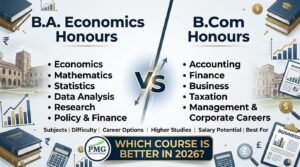
1. B.A. Economics Honours vs B.Com Honours: Quick Comparison
Factor B.A. Economics Honours , B.Com Honours Core focus Economics & economic analysis
Commerce & business
Major areas Microeconomics, Macroeconomics,
Mathematics,Statistics,EconometricsAccounting, Finance,Taxation, Business Law, Management
Mathematics High Moderate, depending on curriculum
Statistics Important Important Economic theory Very high Moderate.
Accounting Limited compared with B.Com
Major component
Finance Strong quantitative foundation
Directly integrated into curriculum
Econometrics Important Usually less central
Business studies Limited Strong
Data analysis Increasingly important useful and
increasingly relevant
Research Strong pathway Possible pathway
Finance careers Excellent with additional skills
Excellent Consulting Strong Strong
Government exams Strong Strong
MA Economics Directly relevant Depends on programme eligibility
MBA Excellent Excellent , Best suited for Students who enjoy
Economics + Maths Students interested in
commerce, accounting & business
The important takeaway is simple:
Economics Honours is more economics-and-quantitative focused, while B.Com
Honours is more commerce-and-business focused.
2. What Is B.A. Economics Honours?
B.A. Economics Honours is an undergraduate degree focused on understanding
how individuals, firms, markets and economies make decisions.
Students study topics such as:
Microeconomics , Macroeconomics Mathematical Methods, Statistics Econometrics Development Economics, International Economics,Public Economics,Indian Economy
Financial Economics,Economic Policy,Research methods
At Delhi University, Economics Honours has a significant quantitative component.
The degree therefore requires students to become comfortable with mathematics,
statistics, models, graphs and analytical reasoning.
It is not simply an advanced version of Class 12 Economics.
University-level Economics is substantially more analytical.
3. What Is B.Com Honours?
B.Com Honours focuses on commerce, business and financial systems.
Depending on the university and curriculum, students may encounter subjects
such as:
Financial Accounting
Corporate Accounting
Business Law
Cost Accounting
Management Accounting
Financial Management
Taxation
Business Economics
Marketing
Human Resource Management
Business Organisation
Corporate Finance
Auditing
Business Statistics
The course is designed to provide a broader understanding of how businesses
operate and how financial and commercial activities are managed.
For students who enjoy accounting, finance and business, B.Com Honours can be a
natural choice.
4. The Biggest Difference Between Economics and Commerce
The easiest way to understand the difference is to imagine a company increasing
the price of its product.
An Economics student might ask:
“How will consumers respond to the price change?”
They may analyse:
Demand
Elasticity
Consumer behaviour
Market structure
Competition
Income effects
A Commerce student might ask:
“How will this affect the company’s revenue, accounts and financial performance?”
They may analyse:
Revenue
Costs
Profit
Financial statements
Tax implications
Business decisions
Both approaches are valuable.
They simply answer different kinds of questions.
5. Economics Honours: What Will You Study?
Economics Honours generally revolves around five major areas.
Microeconomics
Microeconomics studies individual economic agents and markets.
You may study:
Consumer behaviour
Demand and supply
Production
Costs
Market structures
Welfare
Market failure
Macroeconomics
Macroeconomics studies the economy as a whole.
Topics include:
National income
Inflation
Unemployment
Economic growth
Monetary policy
Fiscal policy
Business cycles
Mathematics
Mathematics is a major part of undergraduate Economics.
Students may encounter:
Functions
Differentiation
Optimisation
Partial derivatives
Matrices
Mathematical models
Comparative statics
Statistics
Statistics helps economists analyse data.
Students may study:
Probability
Random variables
Distributions
Statistical inference
Correlation
Covariance
Regression-related concepts
Econometrics
Econometrics combines Economics, Mathematics and Statistics to analyse real
world economic relationships.
This can become particularly useful for students interested in:
Data analysis
Economic research
Policy research
Financial analysis
Quantitative careers
6. B.Com Honours: What Will You Study?
B.Com Honours usually has a stronger business and accounting orientation.
Students may study:
Accounting
Financial accounting
Corporate accounting
Cost accounting
Management accounting
Finance
Financial management
Investment decisions
Capital structure
Corporate finance
Business
Business organisation
Marketing
Management
Human resources
Law and Taxation
Business law
Corporate law
Taxation
Economics and Statistics
Economics and quantitative subjects can also form part of the programme, but
they usually do not dominate the degree in the same way as they can in Economics
Honours.
7. Is Economics Honours More Difficult Than B.Com Honours?
There is no universal answer.
The difficulty depends on your strengths.
However, Economics Honours can feel particularly challenging for students who are
uncomfortable with Mathematics and Statistics.
A typical Economics student may have to deal with:
Economic theory + Mathematics + Statistics + Graphs + Models + Analytical writing
B.Com students may face their own demanding areas, particularly:
Accounting + Finance + Taxation + Business law + Quantitative subjects
So instead of asking:
“Which degree is easier?”
ask:
“Which subjects am I naturally more comfortable learning?”
That is a much better question.
8. Mathematics: Economics vs B.Com
This is one of the biggest differences.
Economics Honours
Mathematics can become an integral part of the degree.
Students may use mathematical methods for:
Optimisation
Utility maximisation
Profit maximisation
Cost minimisation
Economic modelling
Comparative statics
Mathematics can also become increasingly important when preparing for
postgraduate Economics programmes.
B.Com Honours
B.Com also involves quantitative work, but the nature and intensity depend on the
curriculum.
Students may use quantitative methods for:
Financial calculations
Statistics
Cost analysis
Financial management
Business decisions
If you strongly dislike Mathematics, you should investigate the exact curriculum
before selecting either programme.
But students considering Economics Honours should be particularly prepared for
quantitative study.
9. What If You Were Good at Class 12 Economics?
Being good at Class 12 Economics is a good starting point.
But it does not automatically mean that Economics Honours will feel easy.
School Economics often focuses on:
Concepts
Diagrams
Definitions
Applications
Numerical questions
University Economics can involve:
Formal models
Mathematical derivations
Statistical analysis
Proofs
Quantitative problem-solving
More detailed economic reasoning
So before choosing Economics Honours, ask yourself:
Do I enjoy understanding how an economic model works, or do I only enjoy
memorising economic concepts?
If you genuinely enjoy analysing economic relationships, Economics Honours may
suit you very well.
10. What If You Love Accounting?
This is where B.Com Honours may have an advantage.
If you genuinely enjoy:
Balance sheets
Financial statements
Accounting standards
Corporate accounts
Cost accounting
Taxation
Financial management
then B.Com Honours may feel more natural.
Economics Honours is not designed primarily to train students as accountants.
So choosing Economics simply because you scored well in school Economics may
not be the best decision if your actual interest lies in accounting and commerce.
11. Economics Honours vs B.Com Honours for Finance Careers
This is one of the most common questions students ask.
Can Economics students enter finance?
Absolutely.
Economics graduates can pursue roles such as:
Financial Analyst
Equity Research Analyst
Risk Analyst
Investment Banking Analyst
Corporate Finance Analyst
Research Analyst
Business Analyst
However, students may need to develop additional skills such as:
Excel
Financial modelling
Accounting
Valuation
Financial markets
Data analysis
Can B.Com students enter finance?
Yes.
B.Com naturally provides exposure to:
Accounting
Finance
Business
Corporate structures
This can be useful for finance-related careers.
Which is better?
Neither degree automatically guarantees a finance career.
Your skills, internships, academic record, networking and professional preparation
matter significantly.
12. Economics vs B.Com for Investment Banking
Investment banking is another popular career goal.
Students from both Economics and Commerce backgrounds can explore
investment banking.
For Economics students, useful additional skills include:
Accounting fundamentals
Financial modelling
Valuation
Excel
Corporate finance
Financial markets
For B.Com students, Economics and quantitative analysis can be useful additions.
Therefore:
Economics + Finance Skills
and
Commerce + Strong Analytical Skills
can both create strong profiles.
The degree is only one part of the equation.
13. Economics vs B.Com for Consulting
Consulting firms recruit graduates from multiple academic backgrounds.
Economics students can bring:
Analytical reasoning
Quantitative skills
Economic thinking
Data analysis
B.Com students can bring:
Business knowledge
Accounting
Finance
Commercial understanding
For consulting, both backgrounds can work.
But regardless of your degree, you should develop:
Problem-solving
Communication
Presentation
Excel
Case-study skills
Business awareness
14. Economics vs B.Com for Data Analytics
This is an increasingly important comparison.
Economics has a natural quantitative component through:
Statistics
Econometrics
Mathematics
Data interpretation
Students who add:
Python
R
SQL
Excel
Power BI
can build strong analytical profiles.
B.Com students can also enter analytics, particularly business analytics and
financial analytics, but may need to deliberately build their technical skills.
If your primary interest is Economics + Data, Economics Honours can provide a
particularly relevant academic foundation.
15. Economics vs B.Com for MBA
Both degrees can be excellent for MBA preparation.
MBA programmes generally accept students from diverse undergraduate
backgrounds, subject to the eligibility criteria of the particular institution.
Economics advantage
Economics can develop:
Quantitative reasoning
Analytical thinking
Economic understanding
Data interpretation
B.Com advantage
B.Com can provide:
Accounting knowledge
Finance exposure
Business concepts
Corporate understanding
For MBA entrance examinations, your undergraduate course alone will not
determine your result.
Your entrance preparation matters significantly.
16. Economics vs B.Com for MA Economics
This is where Economics Honours has a clear academic advantage.
If your goal is:
B.A. Economics →
MA Economics
then Economics Honours is generally the more directly aligned undergraduate
background.
Students targeting competitive postgraduate Economics programmes need strong
foundations in:
Microeconomics
Macroeconomics
Mathematics
Statistics
Econometrics
Therefore, if you already know that you want to pursue Economics at postgraduate
level, Economics Honours is usually the more natural route.
17. Economics vs B.Com for DSE
Students interested in pursuing postgraduate Economics at the Delhi School of
Economics should understand one important point:
DSE-level Economics is highly quantitative.
That makes undergraduate Mathematics and Statistics extremely important.
An Economics Honours degree naturally provides exposure to these areas.
However, eligibility requirements and entrance/admission rules can change.
Students should always check the latest official admission notification before
applying.
The broader lesson is:
If DSE Economics is your target, start building your quantitative foundation early.
18. Economics vs B.Com for Government Jobs
Both degrees can be useful for government careers.
Depending on the examination and eligibility requirements, graduates can explore:
Civil Services
Banking examinations
SSC examinations
Regulatory institutions
Public-sector opportunities
Research-related roles
Government economic and policy roles
The degree does not automatically guarantee selection.
Competitive examinations require dedicated preparation.
Economics can be particularly useful for students interested in economic policy
and analytical roles, while B.Com can be useful for students interested in banking,
finance and commerce-related areas.
19. Economics vs B.Com for Entrepreneurship
If you want to start a business, both degrees can help—but in different ways.
Economics can help you understand:
Markets
Demand
Pricing
Competition
Consumer behaviour
Incentives
B.Com can help you understand:
Accounting
Finance
Business operations
Taxation
Corporate structures
Entrepreneurship requires knowledge from both worlds.
20. Salary Comparison: Economics vs B.Com
This is where students need to be realistic.
There is no fixed salary attached to either degree.
Your salary can depend on:
College
Academic performance
Skills
Internship experience
Job role
Industry
Location
Company
Communication skills
Technical skills
Higher qualifications
An Economics graduate with strong data and finance skills may outperform another
Economics graduate who has no practical skills.
Similarly, a B.Com graduate with strong accounting, finance and professional
qualifications may outperform another B.Com graduate with only a degree.
So don’t choose a course only because someone promises:
“This degree guarantees a ₹10–20 LPA package.”
No undergraduate degree can guarantee that.
21. Career Options After Economics Honours
Economics graduates can explore careers in:
Finance
Financial Analyst
Equity Research
Corporate Finance
Investment Banking
Risk Analysis
Consulting
Management Consulting
Strategy
Business Consulting
Research
Analytics
Data Analyst
Business Analyst
Economic Analyst
Research Analyst
Research
Economic Research
Market Research
Policy Research
Public Policy
Think Tanks
Policy Institutions
Government-related organisations
Development organisations
Higher Education
MA Economics
Research
PhD
Academic careers
22. Career Options After B.Com Honours
B.Com graduates can explore:
Accounting
Accountant
Audit roles
Financial reporting
Finance
Financial Analyst
Corporate Finance
Banking
Investment-related roles
Taxation
Tax-related roles
Compliance
Advisory
Business
Business Analyst
Operations
Sales
Marketing
Management
Professional Qualifications
B.Com can also complement professional pathways such as:
CA
CMA
CS
CFA
ACCA
Students should separately evaluate the eligibility, examination structure and
workload of each qualification before committing to one.
23. Economics vs B.Com for CA
If your primary objective is to become a Chartered Accountant, B.Com can provide
a particularly relevant academic environment because accounting, taxation and
business-related subjects are closely connected to the CA pathway.
However, students from other undergraduate backgrounds can also pursue
professional qualifications subject to the relevant rules.
The important question is:
Do you want your undergraduate degree to be closely aligned with accounting and
commerce, or do you want a broader quantitative Economics education?
24. Economics vs B.Com for CFA
Both Economics and B.Com students can pursue CFA-related careers and finance
pathways.
Economics can provide:
Quantitative thinking
Economics
Statistics
Analytical reasoning
B.Com can provide:
Accounting
Finance
Business knowledge
For finance careers, the strongest combination is often:
Degree + Finance Knowledge + Technical Skills + Internship Experience
rather than the degree title alone.
25. Which Course Is Better for Students Who Love Mathematics?
Economics Honours
If you enjoy:
Mathematics
Graphs
Statistics
Logical reasoning
Models
Data
Economics Honours may be a strong choice.
B.Com Honours
If you prefer:
Accounting calculations
Finance
Business
Commercial applications
B.Com may be more suitable.
Neither course is completely free of quantitative work.
26. Which Course Is Better for Students Who Hate Mathematics?
This requires honest thinking.
If you strongly dislike Mathematics, Economics Honours may be challenging
because quantitative methods form a meaningful part of the programme.
You should not choose Economics simply because:
“I liked Economics in Class 12.”
University Economics is more mathematical and analytical.
If your interests are more strongly connected to accounting, management,
business or commerce, B.Com may be worth considering.
However, check the exact curriculum of your target university before making a
decision.
27. Economics vs B.Com for Students Interested in Research
Economics has a strong research orientation.
Students may eventually work with:
Economic datasets
Statistical methods
Econometric models
Policy questions
Academic literature
This can be useful for students considering:
MA Economics
Research
Public Policy
PhD
Think tanks
B.Com students can also pursue research, particularly in:
Finance
Accounting
Business
Management
Corporate studies
The research questions are simply different.
28. Economics vs B.Com for Public Policy
Economics has a natural connection with public policy.
Economic policy involves questions such as:
How should taxes be designed?
How can inflation be controlled?
What policies can reduce unemployment?
How should public spending be allocated?
How can economic growth be improved?
Economics students learn frameworks for analysing these questions.
B.Com graduates can also enter policy-related careers, particularly where finance,
business and commercial knowledge are relevant.
But if Economics + Policy is your primary interest, Economics Honours is generally
the more direct academic route.
29. Which Course Is Better for Banking?
Both can work.
Economics
Useful for:
Economic analysis
Banking economics
Data analysis
Policy understanding
Quantitative roles
B.Com
Useful for:
Accounting
Finance
Banking operations
Financial management
Commerce
Your banking career will depend heavily on the specific role you target.
30. CUET and Admission Considerations
Students choosing between Economics Honours and B.Com Honours should not
look only at the course name.
Admission requirements can differ between programmes and universities.
For Delhi University Economics Honours, Mathematics/Applied Mathematics is an
important CUET requirement under the current 2026 admission framework.
Students should check the latest DU Undergraduate Bulletin before selecting their
CUET subjects.
For B.Com Honours, the required CUET subject combination and eligibility should
similarly be checked against the latest official admission information for the
relevant university and year.
Never select CUET subjects based only on an old YouTube video or previous-year
article.
Admission rules can change.
31. Economics Honours vs B.Com Honours: Which Has Better Scope?
The honest answer is:
Both have excellent scope—but the scope is different.
Economics can provide a strong foundation for:
Economics
Finance
Consulting
Analytics
Research
Public policy
Higher education
B.Com can provide a strong foundation for:
Accounting
Finance
Banking
Taxation
Business
Management
Professional qualifications
The best course depends on the direction you want to take.
32. Which Course Has More Career Flexibility?
Economics can be highly flexible because it combines:
Economics + Mathematics + Statistics + Analytical Thinking
B.Com can also be highly flexible because it combines:
Accounting + Finance + Business + Commercial Knowledge
Neither should be viewed as a “limited” degree.
Your flexibility increases when you add practical skills.
33. Skills Economics Students Should Build
Regardless of your college, Economics students should consider developing:
Technical Skills
Excel
Advanced Excel
Statistics
Econometrics
SQL
Python
R
Power BI
Data visualisation
Finance Skills
Accounting basics
Financial modelling
Valuation
Financial markets
Professional Skills
Communication
Presentation
Research
Writing
Problem-solving
34. Skills B.Com Students Should Build
B.Com students can strengthen their profiles with:
Finance
Financial modelling
Investment analysis
Corporate finance
Accounting
Advanced accounting
Accounting software
Financial reporting
Technology
Excel
SQL
Power BI
Data analytics
Professional Skills
Communication
Presentation
Business writing
Problem-solving
The modern job market increasingly rewards students who combine their degree
with practical skills.
35. What Should You Choose Based on Your Career Goal?
If you want MA Economics:
Choose Economics Honours
If you want Economics research:
Choose Economics Honours
If you want Public Policy:
Economics Honours can be an excellent choice
If you want Investment Banking:
Both can work
If you want Corporate Finance:
Both can work
If you want Accounting:
B.Com Honours
If you want CA:
B.Com can be particularly aligned
If you want Business/Management:
B.Com can be a strong option, though Economics also works
If you want Data Analytics:
Economics can be particularly strong if combined with technical skills
If you want MBA:
Both are excellent undergraduate backgrounds
36. A Simple Decision Tree
Ask yourself these five questions.
Question 1
Do I genuinely enjoy Economics?
Yes →
Continue
No →
Consider B.Com or another programme
Question 2
Am I comfortable with Mathematics?
Yes →
Economics remains a strong option
No →
Carefully evaluate the Economics curriculum
Question 3
Do I enjoy Accounting?
Yes →
B.Com may be a strong fit
No →
Economics may be more suitable
Question 4
Do I want MA Economics/DSE/research?
Yes →
Economics Honours has a strong advantage
Question 5
Do I want Accounting/CA/commerce-focused careers?
Yes →
B.Com may be the more natural choice
37. Common Myths About Economics vs B.Com
Myth 1: Economics has no career options.
Reality:
Economics can lead to careers in finance, consulting, analytics, research, policy and
more.
Myth 2: B.Com is only for becoming an accountant.
Reality:
B.Com graduates can pursue finance, banking, consulting, management, business
and professional qualifications.
Myth 3: Economics students cannot enter finance.
Reality:
Economics graduates can enter finance, especially when they develop accounting,
financial modelling and market knowledge.
Myth 4: B.Com students cannot enter consulting.
Reality:
B.Com graduates can pursue consulting with strong analytical, communication and
case-solving skills.
Myth 5: Economics Honours is just Class 12 Economics at a higher level.
Reality:
University Economics includes significantly more Mathematics, Statistics, modelling
and analytical reasoning.
Myth 6: The degree alone determines salary.
Reality:
Career outcomes depend on skills, experience, internships, academic performance,
role, company and individual preparation.
38. What Should You Do During College?
Whatever course you choose, don’t spend three years only attending lectures and
writing examinations.
First Year
Focus on:
Strong academic foundation
Excel
Communication
Societies
Basic internships
Exploring career options
Second Year
Build:
Technical skills
Projects
Better internships
Networking
Research experience
Third/Fourth Year
Focus on:
Placements
Competitive exams
Higher studies
Professional qualifications
Career specialisation
Your undergraduate degree should be the foundation, not the entire career plan.
39. Economics Honours vs B.Com Honours: Pros and Cons
Economics Honours
Pros
Strong analytical foundation
Strong quantitative training
Excellent for MA Economics
Useful for finance and analytics
Strong research potential
Relevant to public policy
Flexible career pathways
Cons
Mathematics can be demanding
Statistics requires practice
Econometrics can be challenging
Not ideal for students who strongly dislike quantitative subjects
40. B.Com Honours
Pros
Strong accounting foundation
Strong finance exposure
Useful for CA/CMA/CS and related pathways
Business-oriented curriculum
Good finance and banking relevance
Useful foundation for MBA
Cons
Students may need additional technical skills for data-heavy careers
Economics research may require additional preparation
Competitive finance roles still require skills beyond the degree
41. The Real Question: Which Student Are You?
Instead of asking:
“Which course is better?”
ask:
“Which course fits me better?”
Choose Economics Honours if you enjoy:
Economics + Mathematics + Statistics + Data + Analytical Thinking
Choose B.Com Honours if you enjoy:
Accounting + Finance + Business + Commerce + Corporate Concepts
That distinction can save you from choosing a course simply because it is popular.
42. Final Verdict: Economics Honours or B.Com Honours?
There is no universal winner.
Choose B.A. Economics Honours if:
You genuinely enjoy Economics
You are comfortable with Mathematics
You like analytical thinking
You are interested in research
You want MA Economics
You are interested in DSE or postgraduate Economics
You want to explore economics, analytics, finance or public policy
Choose B.Com Honours if:
You enjoy Accounting
You are interested in Finance and Commerce
You are considering CA/CMA/CS or related professional pathways
You enjoy business subjects
You want stronger exposure to accounting and corporate finance
You are interested in banking, business or management
And if you are still confused, remember:
There is no “better” degree for everyone. There is only a better fit for your goals.
A student who chooses Economics and builds strong quantitative and technical
skills can create an excellent career.
A student who chooses B.Com and develops strong finance, accounting, analytical
and professional skills can do the same.
The degree opens the door.
What you build during those college years determines how far you go.
Frequently Asked Questions
1. Which is better, Economics Honours or B.Com Honours?
Neither is universally better. Economics is more focused on economic theory and
quantitative analysis, while B.Com focuses more on accounting, finance and
commerce.
2. Which is harder?
The answer depends on your strengths. Economics can be particularly demanding
because of Mathematics, Statistics and analytical models. B.Com can be
demanding because of Accounting, Finance, Taxation and other business subjects.
3. Is Mathematics important in Economics Honours?
Yes. Mathematics is an important part of undergraduate Economics, and students
should be prepared for mathematical methods, statistics and quantitative analysis.
4. Can Economics students enter finance?
Yes. Economics graduates can pursue finance careers, particularly when they add
skills such as Excel, financial modelling, accounting, valuation and financial-market
knowledge.
5. Can B.Com students enter investment banking?
Yes. B.Com can provide useful accounting and finance foundations. Students
should additionally develop financial modelling, valuation, Excel and relevant
internship experience.
6. Which is better for an MBA?
Both Economics Honours and B.Com Honours can provide strong foundations for
an MBA.
7. Which is better for MA Economics?
Economics Honours is generally the more directly aligned undergraduate
programme.
8. Which is better for CA?
B.Com can be particularly relevant because of its accounting, taxation and
commerce-oriented curriculum, although students should check the latest
professional-course eligibility rules.
9. Which is better for data analytics?
Economics can be particularly useful because of its quantitative foundation.
However, students from both degrees can enter analytics by developing SQL,
Python/R, Excel, statistics and data visualisation.
10. Can I change my career after choosing either degree?
Yes. Undergraduate degrees do not permanently lock you into one career. Skills,
internships, higher education and professional qualifications can help you change
or specialise your career direction.
11. Is Economics Honours good for students who dislike Mathematics?
Students who strongly dislike Mathematics should think carefully before selecting
Economics Honours because quantitative methods form a meaningful part of the
programme.
12. Does B.Com have better placements than Economics?
There is no universal answer. Placement outcomes vary by college, company, role,
student profile and year. College-wide placement figures should not automatically
be treated as course-specific outcomes.
Conclusion
Choosing between B.A. Economics Honours and B.Com Honours is not simply a
choice between two popular undergraduate degrees.
It is a choice between two different academic approaches.
Economics asks you to understand:
How do individuals, firms and economies behave?
B.Com asks you to understand more directly:
How do businesses, financial systems and commercial activities work?
Both can lead to finance.
Both can lead to consulting.
Both can lead to management.
Both can lead to higher education.
Both can lead to successful careers.
But your choice should be based on your interests, strengths and long-term goals,
not simply on which course appears more prestigious.
If you love Economics, Mathematics, Statistics and analytical thinking, Economics
Honours can be an excellent choice.
If you enjoy Accounting, Finance, Business and Commerce, B.Com Honours may be
the better fit.
The smartest decision is not:
“Which degree has the highest package?”
It is:
“Which degree will I actually enjoy studying, perform well in and build skills around
for the next three to four years?”
Choose the course that matches your goals.
Then build the skills that turn that degree into a career.
PMG Classes
Understand Economics. Build Strong Foundations. Prepare Smarter.
PMG Classes supports students preparing for Economics Honours academics,
CUET and postgraduate Economics entrance examinations with structured
Connect With Us Real-Time
Ready to transform your grades? Reach out to PMG Classes today and let our experts guide you to academic excellence!
Phone: +91 9899312641
Email: manojgargeco@gmail.com
Course Fees & Batch Timings: Please contact us directly for the latest batch schedules and detailed fee structures